 Eileen Yu, Vice General Manager
Published Updated 3 min readTechnical guide
Extrusion blow molding (EBM), injection blow molding (IBM) and stretch blow molding (SBM) all make hollow plastic containers, but they start from different material forms and suit different products. Choosing the right process comes first; choosing the machine follows from it. Tongda builds extrusion blow molding machines, so this guide also tells you when to look elsewhere.
The three processes at a glance
| Extrusion blow molding (EBM) | Injection blow molding (IBM) | Stretch blow molding (SBM) | |
|---|---|---|---|
| Starting form | A parison extruded from pellets | A preform injected onto a core rod | An injection-molded preform, reheated |
| Typical materials | HDPE, PP, PVC | PP, HDPE, PS and similar | PET |
| Typical products | Bottles with handles, jerry cans, drums, IBC and water tanks, technical parts | Small, precise pharmaceutical and cosmetic bottles | Beverage bottles and jars |
| Container size | From 10 mL bottles up to 3,000 L storage tanks | Small containers | Bottles and jars |
| Handles and complex shapes | Yes, including integrated handles | Limited | Limited |
| Flash to trim | Yes, trimmed and reground | No | No |
Extrusion blow molding
An extruder melts HDPE or PP pellets and forms a hollow tube, the parison. The mold closes around it, compressed air blows it against the mold walls, and the part cools and is ejected; the flash is trimmed and can be reground. Because the parison can be large and its wall thickness can be programmed, EBM makes containers with handles, thick corners and large volumes: jerry cans, chemical drums, water tanks and IBC tanks. See how extrusion blow molding works.
Injection blow molding
Molten plastic is injected around a core rod to form a preform, which is then transferred to a blow mold and inflated. There is no flash, and neck finishes are very accurate, so IBM suits small, precise containers such as medical bottles and cosmetic packaging, where tight tolerances matter more than size or handles.
Stretch blow molding
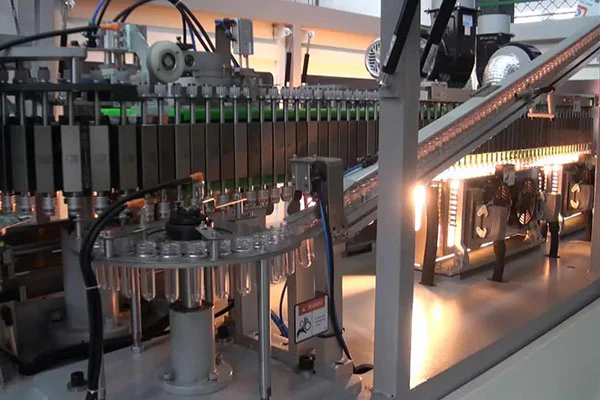
Stretch blow molding is the standard process for PET beverage bottles. It has two stages:
- Injection molding. PET is melted and injected into a mold to form a preform, a small, thick-walled version of the bottle with its finished neck.
- Stretch blowing. The preform is reheated, placed in a blow mold, stretched lengthwise by a stretch rod and blown outward with compressed air, then cooled and ejected.
Stretching orients the material in two directions, which gives PET bottles their clarity, strength and gas barrier with a light weight. SBM machines run at very high output, which suits beverage and pharmaceutical production, and custom molds allow branded shapes.
Which process do you need?
- The container has a handle, is larger than about 5 L, or is a drum, tank or technical part: extrusion blow molding.
- It is a small, precise HDPE or PP bottle for medicine or cosmetics: injection blow molding, or a multi-head small extrusion blow molding machine for 30 mL to 5 L bottles.
- It is a clear PET bottle for water, soft drinks or edible oil: stretch blow molding.
- It is an HDPE bottle for detergent, motor oil or milk: extrusion blow molding; see daily chemical and milk bottle machines.
For more detail on materials, read what is the best material for blow molding and the principle and classification of blow molding machines. When you are ready to compare models, see blow molding machine price and options.