 Eileen Yu, Vice General Manager
Published Updated 4 min readTechnology
Plastic pallets are available in the following four ways:
First: Injection molding.
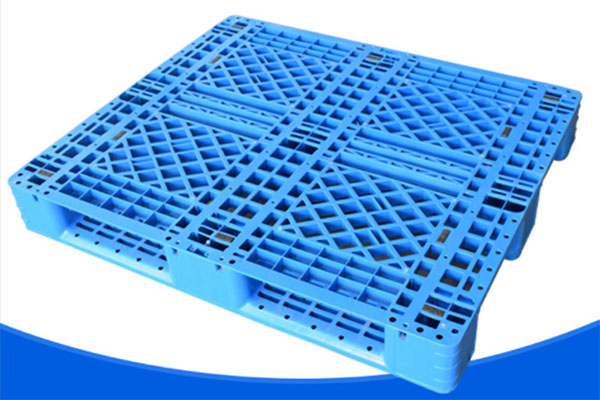
The plastic pallet products produced by the injection molding method are flat, smooth, rigid, compact, and have a large degree of product design freedom. They are divided into double-sided integral plastic pallets and double-sided assembled plastic pallets.
The double-sided integral pallet generally has a weight of more than 15 kg/block, and the shape is relatively complicated, requiring an injection molding machine with a clamping force of more than 2,500 tons. The pallets are complex in shape, large in investment, and relatively high in cost, but due to fewer production processes, relatively high production efficiency and good product quality. At present, there are not many methods used in general plastic processing plants.
The double-sided assembled pallet is divided into upper and lower two-piece pallets, which are respectively assembled by injection molding. Although this product requires 2 pairs of molds, the mold structure is greatly reduced, the total investment of the mold is still cheaper than the whole type, and the requirements for the clamping force of the equipment are also reduced. The clamping force is ≥1500 tons, and it is generally easier for plastic processing plants to implement. This type of production may become the mainstream of plastic pallet production.
Second: Extrusion blow molding.
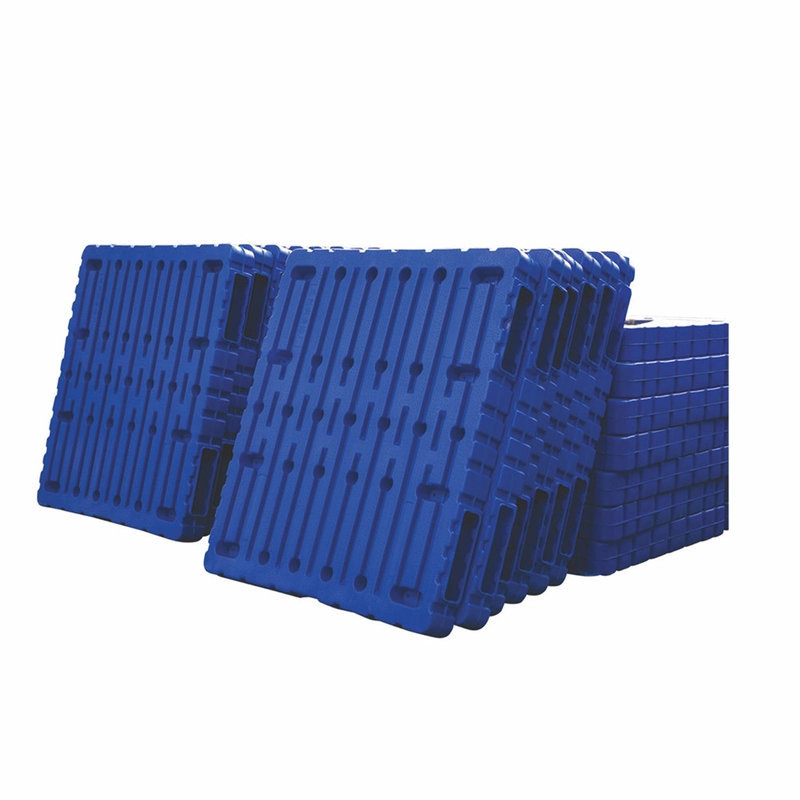
Extrusion blow molding of plastic pallets is similar to the general blow molding method for hollow products, and because of its large size and double-sided type, a large extruder, a mold clamping machine, and a mold are required. At present, domestic blow molding machine manufacturers have developed a large-scale hollow molding machine that specializes in high-speed production of high-strength blow-molded pallets. It is produced by HMWHDPE high-strength plastics. It has fast forming speed, good product quality, high strength and high rigidity. Blow-molded pallets generally have a service life of 5–10 years and work stably at temperatures from −40 °C to 40 °C.
The dynamic load of its products can reach more than 3 t, and the flexural strength reaches a high level. It is the preferred pallet for long-life, high-intensity environments. Although it costs more than other plastic pallets, its long service life gives it the best price/performance ratio. This method will achieve rapid development in recent years as the price of molding equipment is greatly reduced. It will have a great advantage for saving limited oil resources and saving logistics costs.
Third: Vacuum forming method.
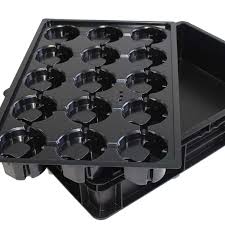
The plastic pallets produced by the vacuum forming method are also available in single-sided and double-sided types. Single-sided blister pallets are mostly used for packaging and transportation of small motors (such as vacuum cleaner motors, power tool motors, etc.) and wire trays. Recently, they have developed rapidly and are mainly used as dedicated pallets for specific products. The double-sided blister pallets are assembled in two forms: the upper half is an extruded fixed length, fixed width plastic sheet, the lower half is a large vacuum blister; the upper and lower half are large vacuum blister Products. The method requires large-scale vacuum blistering equipment for production molding, the equipment cost is low, the mold cost is also low, but the product wall thickness is uneven.
Fourth: Extrusion profile assembly method. The plastic pallets produced by this method are all assembled. That is, an extruder, a machine head, and the like are used to extrude the slats for the upper and lower panels and the I-shaped connecting plates with the compound wings for the connection support, and then assemble them. The advent of wood-plastic composites has driven the development of plastic pallets for extrusion molding. It is based on natural plant fiber (including wood flour husk, straw powder, rice bran, etc.) and waste plastics, so the plastic pallet offers wood-like performance, together with water and insect resistance, and can be planed, sawed and nailed. Among the four molding methods, the production equipment and molds have the least investment, the lowest cost, and the best performance-price ratio.
Five points for producing high-quality blow-molded pallets
-
Size the die head to the mold. Design the die to the width of the mold and use the timing functions for mold closing and blowing to inflate the parison to the right size. Less flash means less energy spent crushing it. Keep the process stable by setting molding time, hydraulic pressure and flow, blowing and cooling water pressure and flow, the wall thickness controller profile and the shot length to suit the product’s shape.
-
Choose the right resin formula. Pallets are usually blown from HDPE. Select the grade for impact, compression and crack resistance while keeping material cost down.
-
Choose the right screw. Screws can be designed for high plasticizing capacity, for even color mixing, or as high-output double alloy screws for both. Pick one to suit the material and product.
-
Design the mold carefully. For double-sided and nine-leg pallets, allow proper draft angles so the part is not overstretched. Reinforcing ribs set the pallet’s strength, so use as many and as strong ribs as the design allows.
-
Keep the regrind ratio reasonable. Mix regrind and virgin material at a ratio confirmed by testing, and blend it evenly. Too much or too little affects product quality.