 Eileen Yu, Vice General Manager
Originally published on WeChat:
English edition published: English edition updated: 4 min readTechnical guide
A 25 L stackable container should be specified as a complete package: container drawing, material, closure, stacking features and intended contents. The blow molding machine must support that product and its acceptance tests. Nominal machine volume alone is not enough to establish suitability.
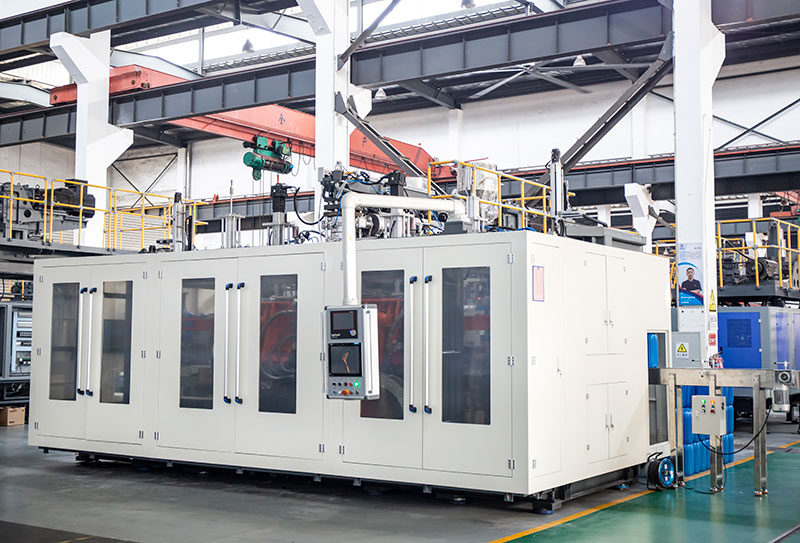
An earlier Tongda website case describes an HS-30L project for 20 L and 30 L chemical drums, with automated take-out, trimming and inspection. The supplied WeChat article adds a separate 25 L example; its model identity and application figures are not assumed to describe that same installation.
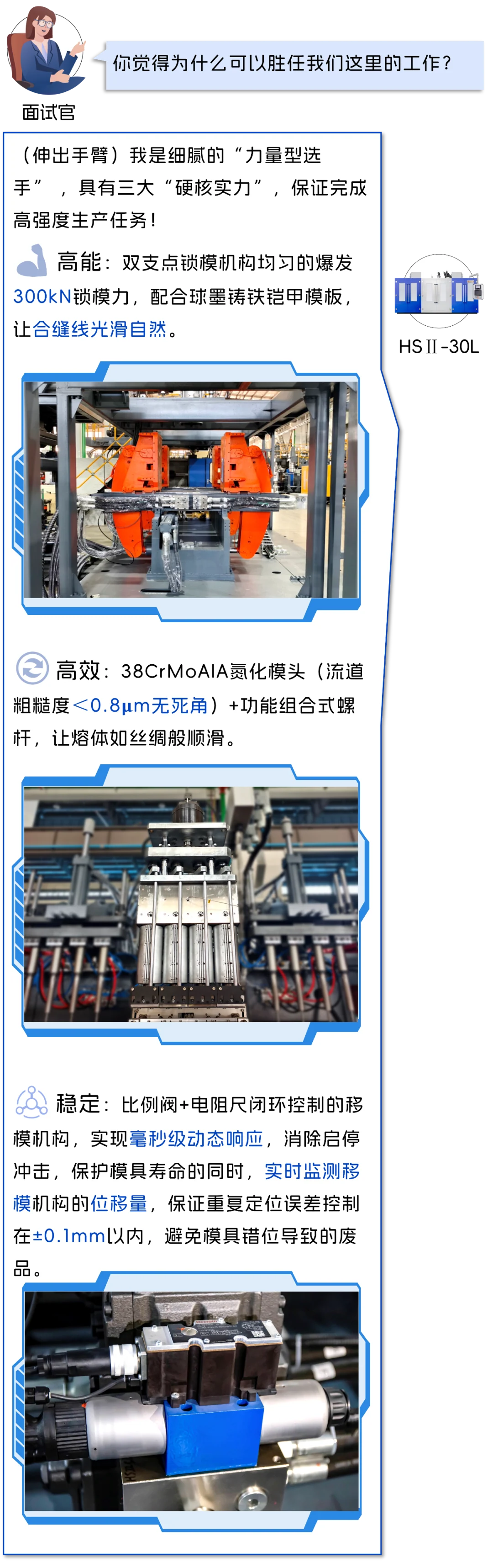
The separate 25 L source reports a 25 L product around 1,300 g, a stated weight tolerance of ±20 g and a 30–35-second cycle. These are application figures from the source, not guaranteed performance for every 30 L machine configuration.
Start with stacking geometry and the closure
Identify the contact areas between stacked containers and how the load passes through the shoulder, base and surrounding walls. Specify the fill condition, stack arrangement, duration and environment used to assess the package. An empty container standing upright does not demonstrate performance in a filled stack.
Include neck finish, cap, sealing system and any handle requirements in the drawing package. Ask how those features will be formed, trimmed and checked. The accepted mold and closure should be part of the trial rather than items selected after machine acceptance.
Read cycle and output figures on the same basis
Theoretical output requires both the cycle definition and the number of parts produced per counted cycle. With one part per cycle and uninterrupted operation, the source range gives:
| Complete cycle | Theoretical parts per hour | Calculation |
|---|---|---|
| 30 seconds | 120 | 3,600 ÷ 30 |
| 35 seconds | About 103 | 3,600 ÷ 35 |
This calculation does not account for rejects, downtime or downstream limits. A double-station arrangement must also be described clearly: does the quoted time refer to one station, a complete machine sequence or the interval between delivered parts? Do not double the result simply because two stations are present.
Use a timed production trial to count accepted containers at the agreed line boundary. Record rejects by cause and include the handling operations needed to deliver the finished package.
Check local walls as well as total weight
A part can meet its average weight target while having a weak corner, shoulder or pinch-off. Agree measurement positions before the trial and compare sections from repeated cycles. Investigate variation by cavity or station where applicable.
| Check | Why it matters |
|---|---|
| Local wall sections | Identifies thin regions hidden by the overall weight |
| Neck dimensions and sealing | Connects molding and trimming to the actual closure |
| Handle and pinch-off | Reviews mechanically demanding areas |
| Filled-stack behavior | Tests the package under its intended support and loading |
| Post-cooling dimensions | Captures changes after the part leaves the mold |
The current HS double-station 30 L page describes a machine option. Confirm the exact model and configuration for a new enquiry rather than treating historical case values as its current data sheet.
Separate flash recovery from recycled content
The source includes a scrap-recovery percentage without a fully defined measurement basis. It should not become a claim about the percentage of recycled resin in every container.
Track flash collection, segregation, granulation and reuse separately. Define the permitted material recipe for the product and intended contents, and check whether recovered material may be used in the proposed layer. Include start-up scrap, color changes and rejected containers in the material balance where relevant.
Questions buyers ask
Does a stable weight prove stacking performance?
No. Weight is one process measure. Wall distribution, geometry, material, closure and the filled-package test determine whether the container meets its specification.
What is a useful acceptance record?
Keep the material and mold identifiers, recipe, trial duration, cycle definition, accepted count, reject reasons and package-test results together. This makes future runs comparable.
For a new project, review stackable-container applications, the chemical drum blow molding machine page and the extrusion blow molding machine catalogue, then send your 25 L container drawing.
Adapted from Tongda’s original WeChat article. Case figures are manufacturer-reported for the described application. Original photographs and English concept illustrations are identified in their captions.