 Eileen Yu, Vice General Manager
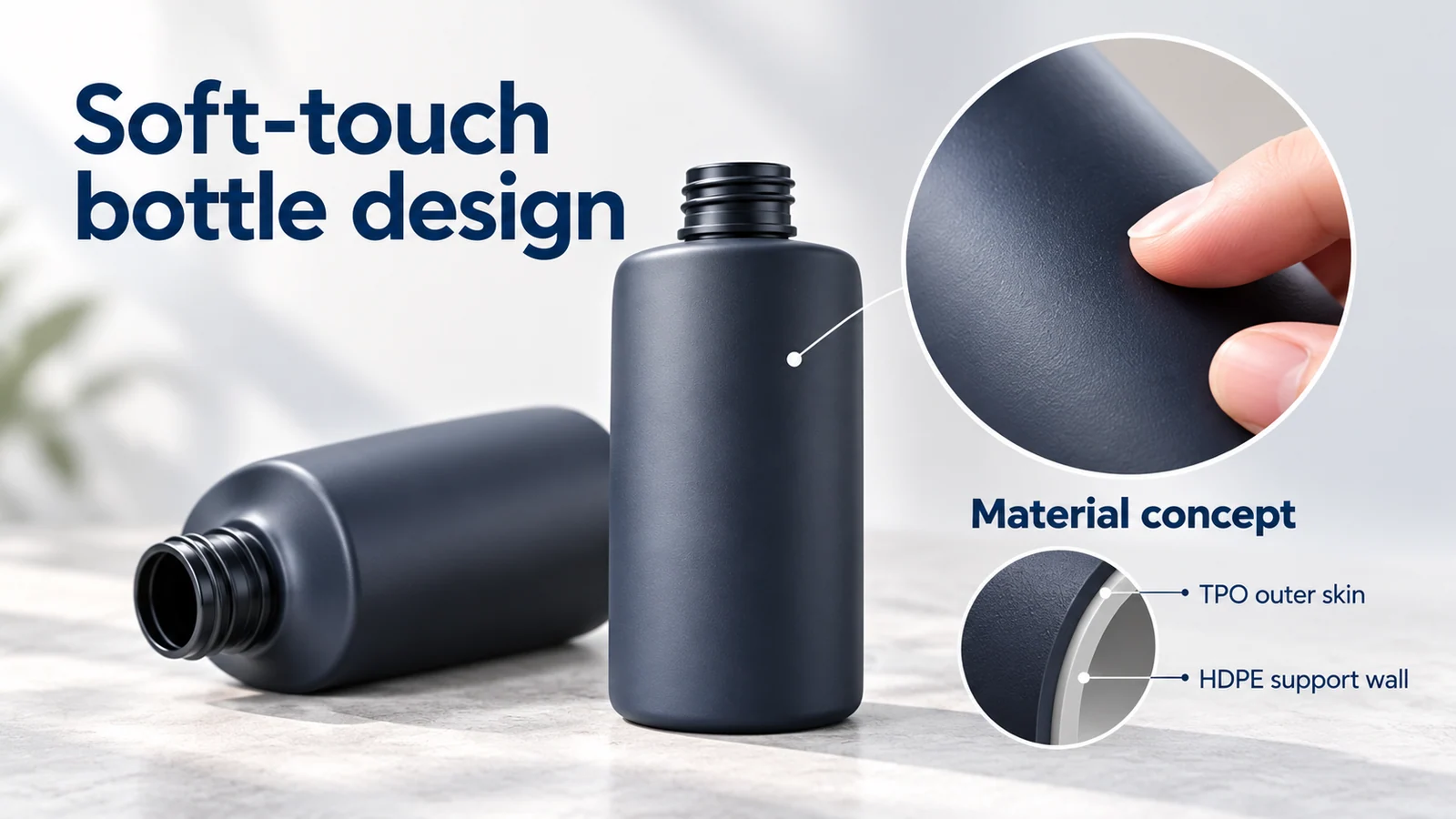
A soft-touch bottle can combine a tactile outer layer with a structural inner wall. Tongda’s source article discusses a TPO outer skin and HDPE inner layer made by co-extrusion blow molding. The material names describe a design approach; the selected grades, layer adhesion, filling compatibility and surface finish still need to be demonstrated together.
For packaging buyers, the useful starting point is an approved sample and a clear definition of the required feel. “Soft,” “matte” and “velvety” describe different characteristics and should not be treated as interchangeable specifications.
Specify the tactile effect before selecting resin
TPO means thermoplastic polyolefin and covers a family of formulations. Ask the resin supplier for a grade intended for the proposed processing method and application. Identify the hardness, color, surface appearance and handling characteristics needed in the finished bottle.
Compare samples under consistent lighting and after the same conditioning period. A surface that feels acceptable immediately after molding may behave differently after filling, storage, rubbing or cleaning. Record which areas are assessed, including the shoulder, grip and label panel.
Give each layer a defined function
In the source concept, the outer TPO layer provides the tactile surface and the HDPE inner layer supports the container structure. This does not establish a universal layer ratio or prove that any two grades will bond well.
| Part of the design | Trial question |
|---|---|
| Outer skin | Is the feel and appearance consistent over the whole bottle? |
| Structural wall | Does the filled container meet its mechanical requirements? |
| Interface | Does the layer bond survive the agreed handling and conditioning? |
| Neck and closure | Are dimensions, sealing and opening behavior repeatable? |
| Decoration | Does the chosen label, ink or treatment remain attached? |
Inspect molded sections as well as the external surface. A visually attractive bottle may still have a thin shoulder, an uneven outer layer or an interface problem that appears only during testing.

Configure the co-extrusion process around the grades
Specify the melt streams and die-head arrangement needed for the proposed structure. Layer count and extruder count are different design questions; the equipment supplier should identify how each material reaches the intended layer.
Trial the actual resin combination and color system. Set the temperature profile, throughput balance, parison programming, blowing and cooling conditions from the selected materials and tooling. Avoid transferring an HDPE-only recipe to a soft-touch combination without verification.
Check layer continuity around the neck, shoulder, base and pinch-off. Keep the accepted recipe and section samples with the product revision so a repeat order can be evaluated against the same reference.
Test decoration and the complete filled pack
Test labels and printing on the actual molded surface, including any specified pretreatment. The choice of ink or adhesive must match the resin and service conditions. Appearance approval alone does not establish decoration durability.
Run the relevant filled-package checks using the intended contents and closure. These may include leakage, drop performance, squeezing and top-load behavior as defined by the packaging specification. Record the duration and conditions rather than describing the pack simply as “strong” or “flexible.”
Evaluate recovery using the complete material structure
Do not assume that a TPO/HDPE bottle can be placed in every PE or PP recycling stream. The full formulation, additives, decoration, local collection route and recycler requirements matter. Likewise, a reprocessed blend should be tested before claiming that it retains the original tactile effect.
Keep factory flash recovery separate from a consumer-pack recycling claim. A permitted in-process regrind recipe is a manufacturing decision that must still produce an acceptable package.
Questions buyers ask
Is a soft-touch bottle necessarily coated or flocked?
No. The source concept uses a molded outer material layer. Confirm the actual construction rather than inferring it from appearance.
Can I specify a standard outer-layer percentage?
The required distribution depends on the chosen grades, geometry and performance targets. Establish it through trials and section measurements.
See daily chemical bottle applications, the co-extrusion layer-control guide and send a bottle sample specification for an equipment review.
Adapted from Tongda’s original WeChat article. Case figures are manufacturer-reported for the described application. Original photographs and English concept illustrations are identified in their captions.