 Eileen Yu, Vice General Manager
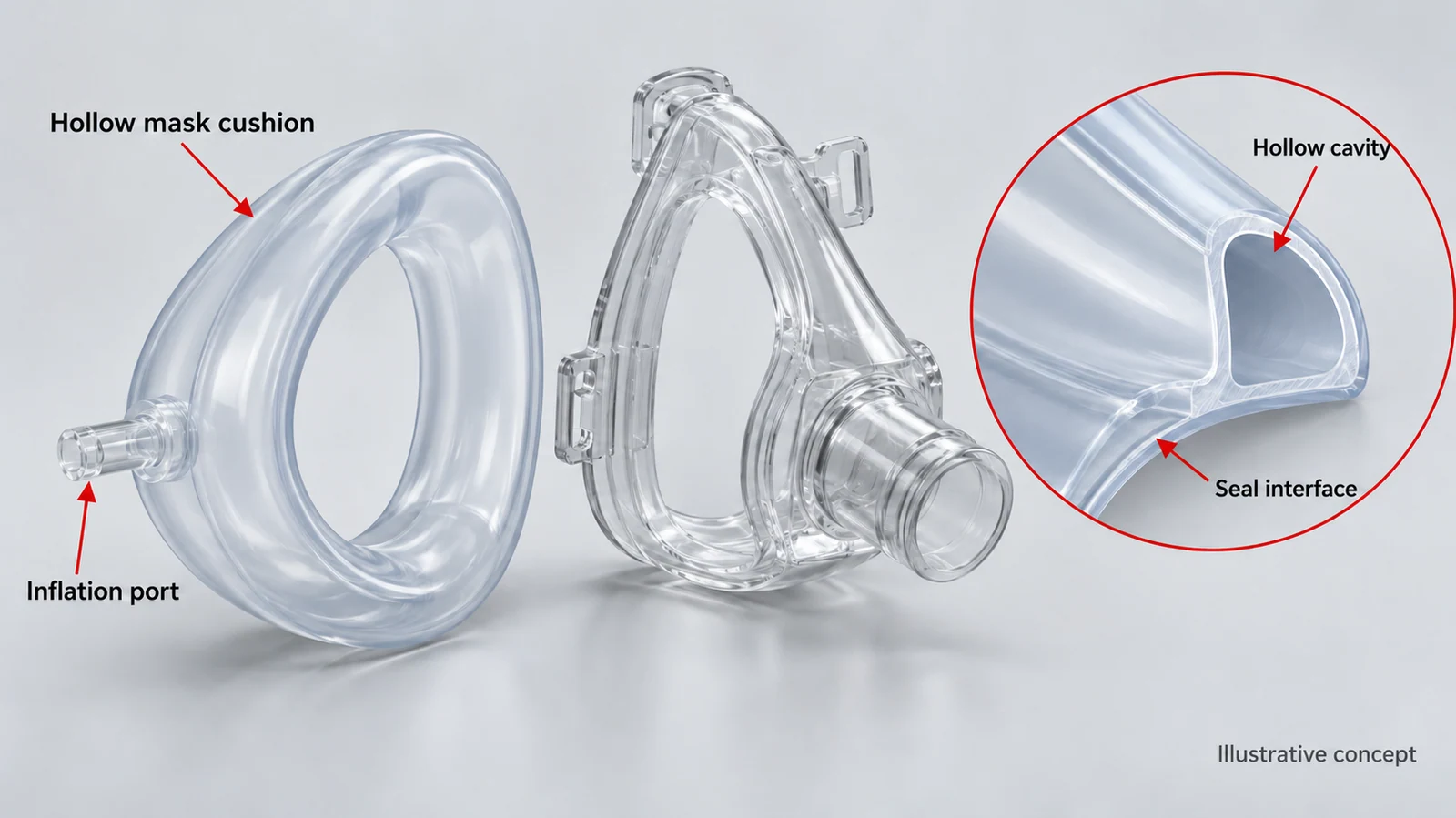
Blow molding can form a hollow mask-cushion component when the material, geometry, tooling and joining method suit the process. Equipment selection should begin with the device manufacturer’s component specification. A successful molding trial demonstrates manufacturing performance; it does not establish the clinical performance or qualification of the finished medical device.
Tongda’s source article describes an HTSII-2L application for this type of hollow cushion. The practical questions concern wall consistency, sealing interfaces, process sequencing, handling and traceable inspection.
Define the component and its interfaces
Provide the approved drawing, material formulation, target weight, attachment features and joining process. Identify the hollow region, inflation or filling connection where applicable, and the surfaces that must fit the other device components.
Specify dimensions and local-wall requirements using a defined inspection method. A controller’s movement resolution does not directly establish the finished cushion’s dimensions, softness or sealing behavior. Check the molded component and the joined assembly at the relevant stages.
Select the actual compound and processing conditions
The phrase “medical grade” is not a complete material specification. Confirm the compound, additives, supplier documentation and processing requirements with the responsible device manufacturer. Record any permitted material substitutions rather than assuming that similar base polymers are interchangeable.
Use the chosen compound in trials. Examine how the material forms, cools, trims and joins, and whether the resulting component meets the specified mechanical and functional requirements. Changes to color, additives or processing can require review even when the product shape remains unchanged.
Coordinate an interlocked molding sequence
The line must coordinate extrusion, mold closing, blowing, cooling, venting and opening through the machine’s designed safety and process controls. Do not shorten a cycle by bypassing interlocks or opening before the required pressure release.
A faster control response is useful only if the complete sequence remains stable and produces acceptable parts. Agree which point starts and ends the reported cycle, how many components emerge and where accepted output is counted.

Separate equipment features from process qualification
Stainless product-contact components, automatic take-out and controlled handling may address particular production requirements. They do not alone establish a qualified cleanroom process or a compliant finished device.
| Item to specify | Evidence to retain |
|---|---|
| Material and tooling | Approved identifiers and revision history |
| Dimensions and walls | Inspection method, locations and results |
| Joining and leakage | Component or assembly tests appropriate to the design |
| Handling and cleanliness | Defined responsibilities and process records |
| Production output | Timed accepted count and reject categories |
Define cleaning, handling and packaging responsibilities across the complete production route. Include the steps after molding, because trimming, joining, cleaning and packaging can change the condition in which a component reaches final assembly.
Review the finished device with its responsible manufacturer
For US submissions, the FDA’s biocompatibility documentation examples distinguish raw material and component information from the device in its final finished form. The applicable assessment depends on the actual product and its use. A molding-machine case study is not that assessment.
Keep material, tooling and process records traceable to the trial samples. If a later revision changes the compound, surface, joining process or other relevant condition, document the change and have the responsible manufacturer determine the required evaluation.
Questions buyers ask
Does a uniform-looking cushion prove wall consistency?
No. Use the agreed measurement method and locations. Appearance alone cannot establish internal-wall distribution.
Can a general-purpose machine configuration be specified from the cushion volume?
Volume is only one input. Resin, component geometry, tooling, blowing arrangement, handling and inspection determine the required configuration.
Review the HTS 2 L machine platform and the mold-design guide, then request a component manufacturing review with the approved drawing and process requirements.
Adapted from Tongda’s original WeChat article. Case figures are manufacturer-reported for the described application. Original photographs and English concept illustrations are identified in their captions.