 Eileen Yu, Vice General Manager
Blow molding an automotive running board requires a coordinated specification for load paths, mounting points, material, wall distribution and the complete assembly. A long hollow part can be lightweight, but its length or nominal wall thickness alone does not establish its load capacity. Start with the vehicle interface and acceptance tests, then select the machine and mold.
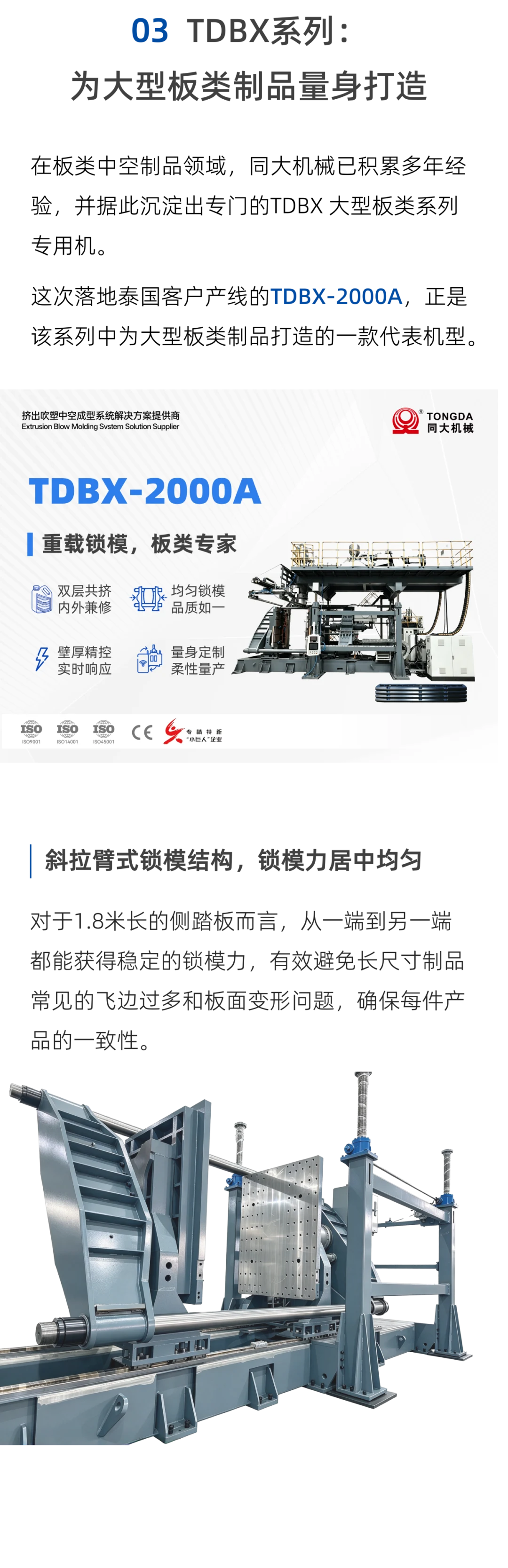
Tongda’s source case describes a TDBX-2000A project for an automotive-parts manufacturer in Thailand. It provides a useful large-part example without establishing a universal design or production rate for other running boards.
Define the running board as an assembled component
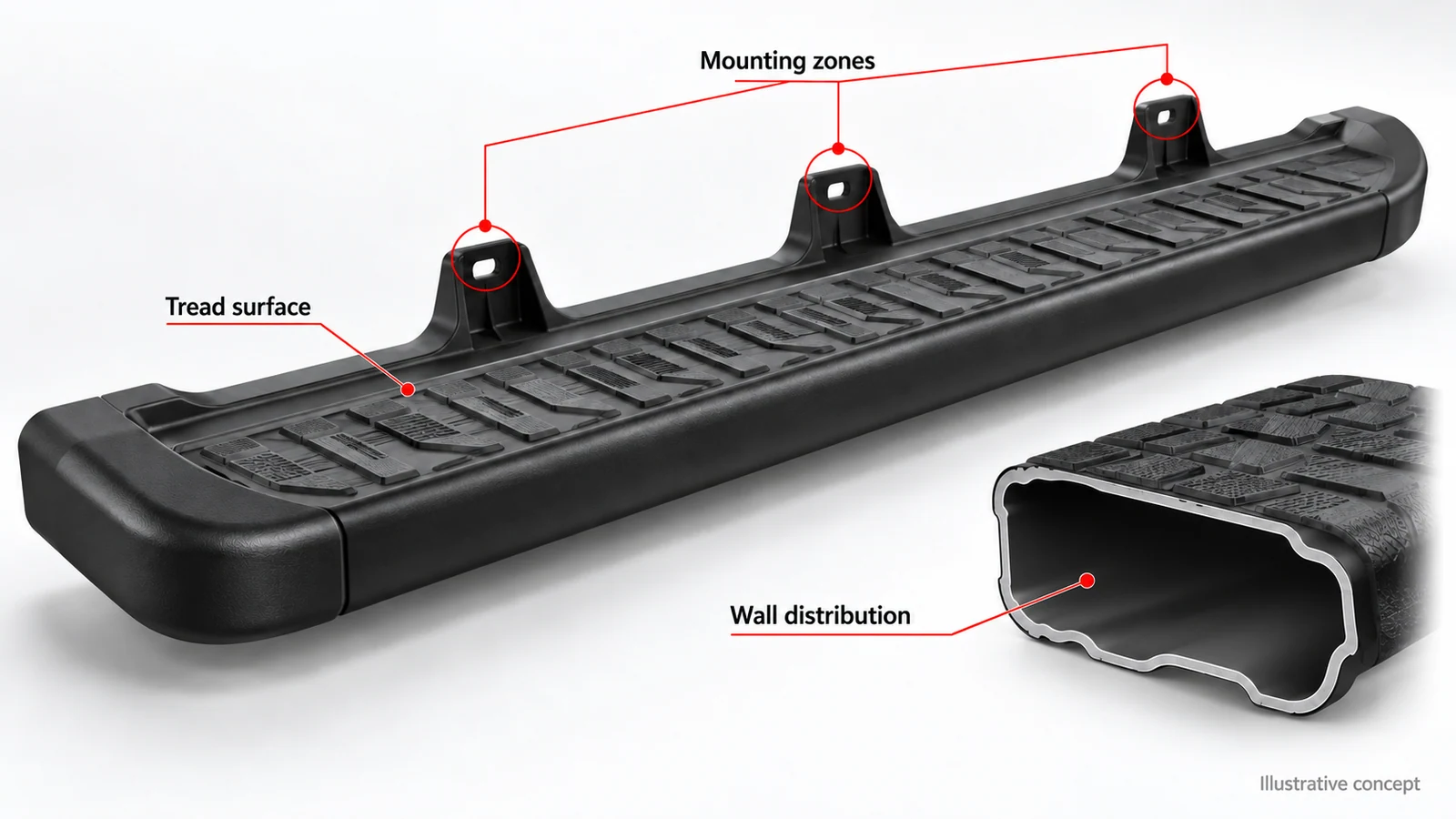
Give the equipment supplier a drawing that identifies the tread surface, brackets, fastening points, permitted deflection and surrounding vehicle clearances. Include the material specification and the conditions under which the complete assembly will be assessed. A part that fits the mold can still require changes to trimming, mounting or downstream handling.
The source reports a part approximately 1.8 m long, about 4.7 kg in weight and a cycle around 160 seconds. Treat these as reported values for that application. They are not standard TDBX-2000A output or strength guarantees. The source also describes an HDPE / glass-fiber-reinforced PP construction; the exact grades, layer arrangement and bonding need a project-specific specification.
Put material where the load requires it
A long parison changes shape as it hangs and stretches into the cavity. The finished distribution depends on melt behavior, discharge timing, tooling and the programmed profile. Increasing the average part weight may leave a critical mounting area too thin while adding unnecessary material elsewhere.
Plan section measurements around the tread, brackets, corners and pinch-off. Record both the minimum local wall and the finished-part weight. Compare these results after the agreed conditioning period, and retain representative samples from the beginning, middle and end of the trial.
Parison control supports this process; it is not a substitute for inspecting molded sections. Moog’s blow molding controls manage parison and machine motion. A controller specification does not by itself certify the wall thickness or load rating of the finished board.
Match the tool and machine to the full part envelope
For a long running board, check more than the nominal machine capacity. Review mold dimensions and mass, platen support, opening clearance, service connections and the path used to remove the part. Check the loaded tool through the whole motion sequence, including trimming and transfer.
| Design area | Evidence to agree before acceptance |
|---|---|
| Mounting zones | Section measurements and assembled load tests |
| Tread and long span | Dimensional checks and deflection under the specified duty |
| Pinch-off and edges | Seam inspection and repeatable trimming |
| Material layers | Grade records, layer continuity and bonding checks |
| Production | Accepted parts per hour, reject causes and trial duration |
Tongda’s case describes a large-part clamping arrangement, programmable parison control and a two-layer accumulator head. Confirm the offered configuration against the current quotation; a shared machine-series name does not make every installation identical.
Compare production cost using accepted parts
Include resin, flash handling, cycle time, energy, labor, tooling maintenance and rejects. Define which operations are included in the quoted cycle. A fast molding step can be constrained by cooling fixtures, trimming or assembly.
For lightweighting, compare against a defined reference design that meets the same functional requirements. Removing a universal percentage claim gives the buyer a more useful question: what mass reduction can this specific assembly achieve while passing its agreed tests?
Questions buyers ask
Can one large-part machine also produce furniture panels or floats?
Potentially, with suitable tooling and configuration. Mold fit, melt demand, materials and handling must be checked for each product. Similar overall size does not establish interchangeability.
What should I send for an application review?
Send the part and bracket drawings, resin grades, target mass, annual demand and test requirements. Include reference samples where available.
Review automotive-part applications and the accumulator-head selection guide, then request a running-board process review.
Adapted from Tongda’s original WeChat article. Case figures are manufacturer-reported for the described application. Original photographs and English concept illustrations are identified in their captions.