Published 4 min readTechnical guide
Six-layer co-extrusion blow molding combines structural polyethylene, bonding layers and an EVOH barrier in one hollow container. The buying decision is whether the selected wall structure protects the actual contents and can be produced consistently. Layer count alone cannot establish barrier performance, shelf life or accepted output.
Tongda’s HS30L-6P-L project illustrates the engineering questions behind a multilayer chemical container: how resin streams reach the die, how layers remain continuous after stretching, and how the finished package is qualified. This guide focuses on those questions rather than treating six layers as a universal specification.
What each layer contributes
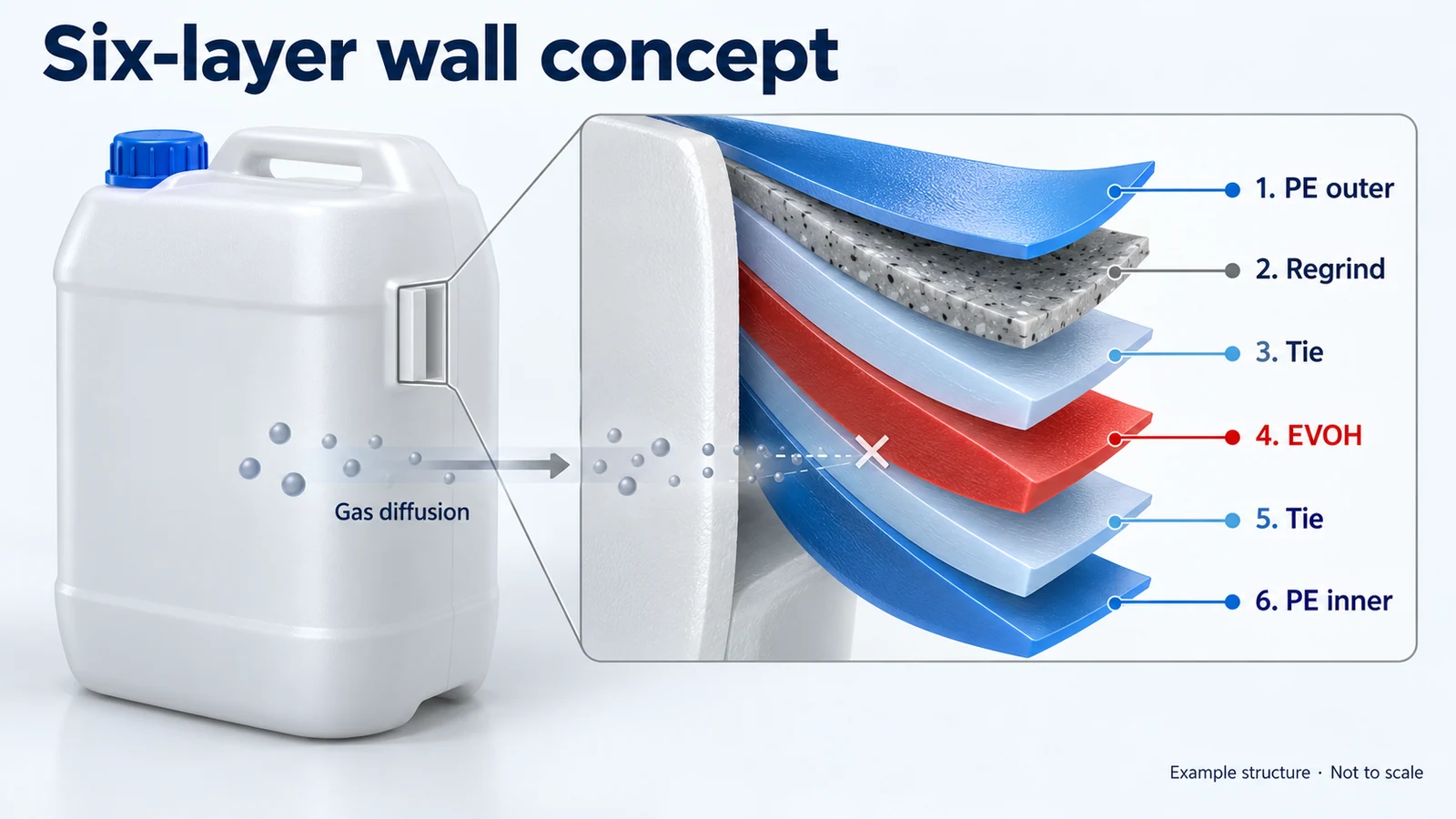
An illustrative six-layer wall can comprise outer PE, a tie layer, EVOH, a second tie layer, a qualified regrind layer and inner PE. This is a conceptual arrangement, not a required order for every product. The material-flow drawing must identify the actual sequence, resin grades and permitted regrind composition.
| Wall component | Main question |
|---|---|
| Outer and inner PE | Do surface, contact and structural properties suit the product? |
| Tie layers | Is bonding adequate between the selected materials? |
| EVOH | Does the grade provide the required barrier under service conditions? |
| Regrind layer | Is its composition controlled and appropriate for this package? |
EVOH is used for gas and selected vapor barriers. It should not be described as the main moisture barrier. Kuraray explains the water sensitivity of EVOH and the protective role of surrounding polyolefins. The needed structure depends on both the packaged formulation and its environment.

Six layers do not require six extruders
The number of physical layers and the number of extrusion units describe different things. A die can divide a material stream between more than one layer. Conversely, two layers that look similar may need separate material supplies when their recipes differ.
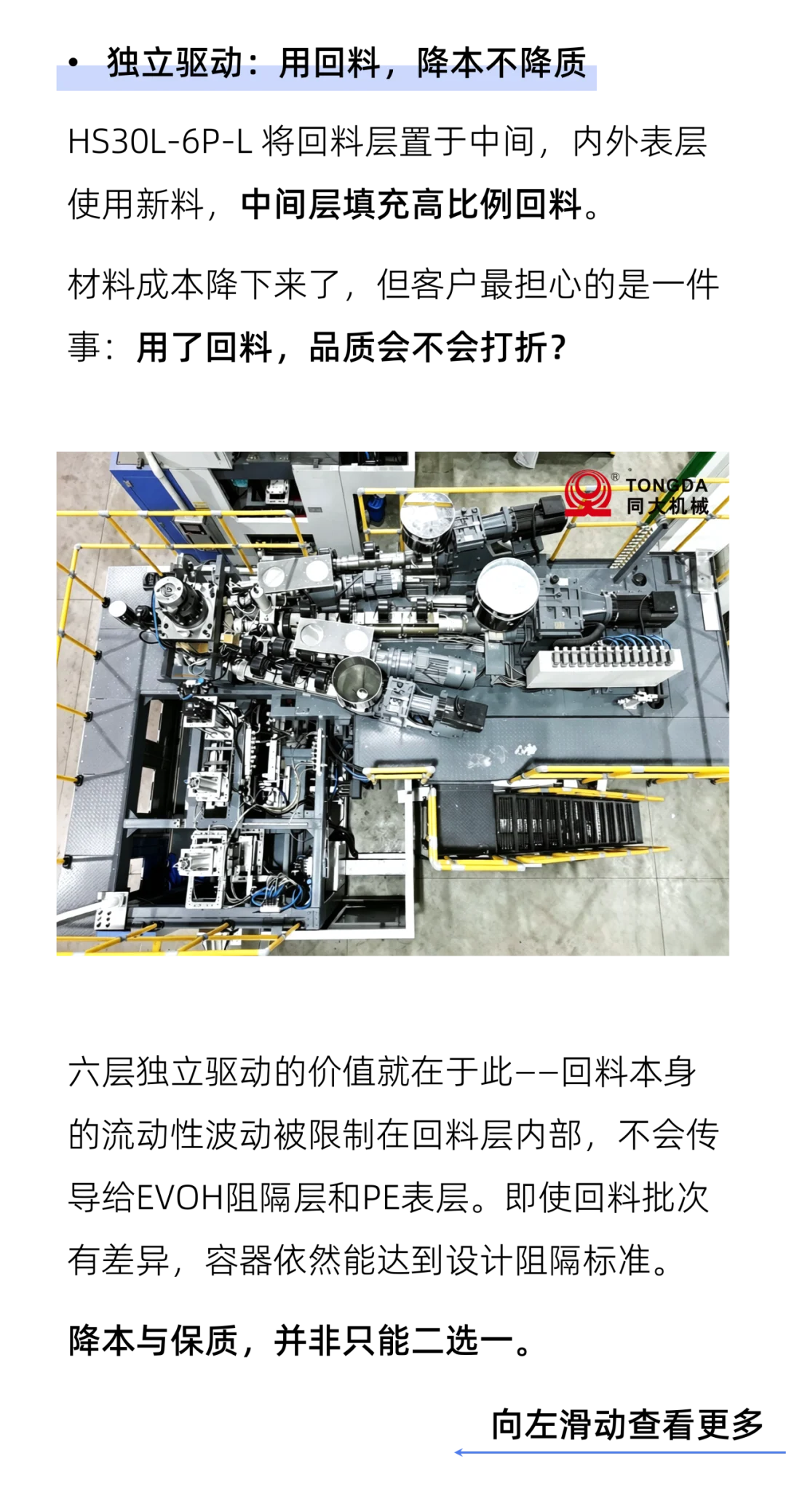
The HS30L-6P-L project description identifies five extrusion units and a six-layer head. These statements can coexist. They do not establish six independent extruder drives or independent adjustment of every layer without further information.
Ask for a stream-to-layer diagram showing the feed, screw, metering method, die passage and resulting layer for each material. Include view-stripe options separately: a level line is not proof that the barrier is continuous around it.
Control individual layers as well as total weight
A stable container weight can conceal a thin or interrupted barrier layer. Total weight, total wall distribution and individual layer continuity therefore need separate measurements. Select sample positions that include highly stretched corners, the shoulder, the base and the pinch-off region.
Parison programming changes the overall extrusion profile. Individual layer distribution also depends on material feed, viscosity, die design and stretching. Increasing the total wall at one position does not demonstrate that the EVOH share increased by the same proportion.
Record resin lot, drying conditions where specified, output settings and the approved recipe alongside section measurements. Use resin suppliers’ processing instructions for the actual grades. A temperature range or minimum layer thickness copied from another application is not an acceptance criterion for a new container.
Validate the complete filled package
Begin with the formulation, intended storage period, temperature range, humidity and handling duty. Agree how permeation, mass loss, appearance, closure performance and mechanical integrity will be evaluated. The bottle wall and closure must work together; changing either can change the result.
Useful trial records include layer sections, bond assessments, filled-package observations and the applicable drop or stacking tests. Define methods and limits before the run. Do not substitute an empty-container demonstration for a filled-package assessment, or extrapolate one formulation’s result to every agrochemical or solvent.
The pesticide-bottle line guide addresses a smaller-package application of this principle. For production equipment, review Tongda’s chemical drum solutions and HS II-30L model, then confirm the specific multilayer configuration.
Establish a defensible output basis
The project material reports a 75–80-second cycle. If one accepted part were produced per counted cycle, uninterrupted theoretical output would be 45–48 parts per hour. That arithmetic excludes rejects, stops, changeovers and downstream limitations; it is not a guaranteed production rate.
Specify the cycle’s start and end points, the number of parts released per event, and the duration of the production trial. Report accepted containers and rejected containers separately. For a complete line, include trimming, cooling, conveying, inspection and packing in the agreed boundary.
Questions buyers ask
Is a six-layer container always better than a three-layer container?
No. A three-layer PE wall and an EVOH-containing wall may serve different purposes. Choose the structure that meets the contents, handling and manufacturing requirements; additional layers add material and process variables to control.
Can a barrier layer be approved from average bottle weight?
No. Average weight cannot establish the continuity or local thickness of an individual layer. Agree a layer-measurement plan and test the filled package using the intended closure.
What should accompany a multilayer equipment enquiry?
Provide the drawing, nominal volume, contents, resin requirements, closure, storage conditions and target accepted output. Request a configuration review with these inputs so the die design, material feeds and acceptance trial can be evaluated together.
Source material: Tongda WeChat article 21. Source photographs and video stills retain the original equipment details. English concept illustrations are identified in their captions.