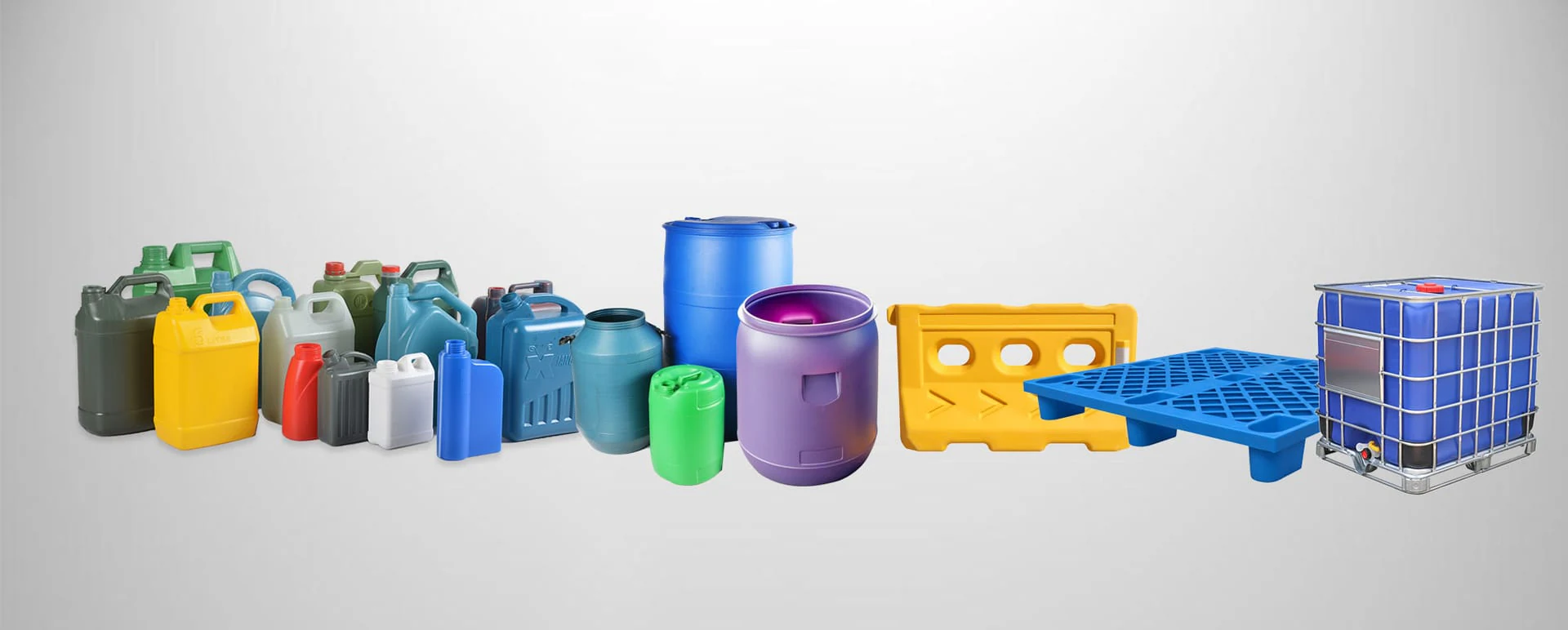
Blow molding machines
Extrusion Blow Molding Machine
What is an extrusion blow molding machine?
An extrusion blow molding machine melts HDPE or PP pellets in a screw extruder, forces the melt through a die head to form a hollow parison, clamps a mould around that parison and blows compressed air until the plastic matches the cavity. Tongda publishes models from 2 L to 1,500 L.
It is the extrusion process, not stretch blow molding of PET preforms. Tongda’s blow molding machine overview compares those processes. This page stays with extrusion: the steps, the parts, continuous versus accumulator-head operation, and the HS, HTS, HSE and TDB figures already published on the model pages.
How does an extrusion blow molding machine work?
The machine turns pellets into a hollow container in one heated cycle. Air does the shaping. The mould only supplies the outside shape and the cooling.
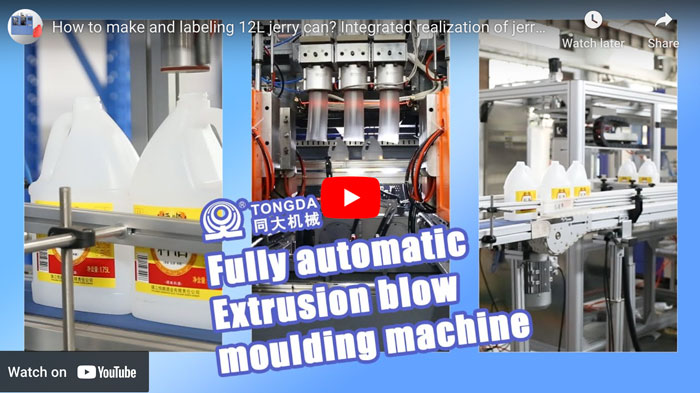
- Pellets are fed to the extruder.
- The screw melts the plastic and pumps it forward.
- The die head forms a hollow tube, the parison.
- The clamping unit closes the mould around the parison.
- A blow pin or needle sends in compressed air and the parison takes the cavity shape.
- The part cools in the mould. The mould opens. Deflashing cuts off the flash left outside the cavity.
Cooling time, mould temperature and the accepted-part test decide how many containers leave the line. An extruder kg/h rating is not a bottle count.
What are the main parts of an extrusion blow molding machine?
Six parts do the work. The control system sets temperatures, timers and the parison profile. It does not replace any of the six.
Extruder
The extruder melts HDPE or PP and delivers a steady flow of melt. Output on Tongda’s parameter tables is given in kg/h for that screw and drive.
Die head and parison
The die head shapes the melt into the parison. On a continuous head the parison keeps coming. On an accumulator head the melt is stored and then discharged as one shot. A programmed die gap can put more material at handles, corners and the base.
Clamping unit
The clamping unit closes and holds the mould while the part is blown and cooled. Clamping force on the model pages is given in kN. A larger container and a higher blow pressure need more clamp.
Mould
The mould is the cavity, the pinch-off and the cooling circuits. It has to fit the platen, the opening stroke and the blow pins of the chosen machine. See the blow mold design and manufacturing guide.
Blowing
Compressed air, through a blow pin or a needle, expands the parison against the cavity. Neck finish and wall distribution depend on the pin, the parison and the cooling, not on air alone.
Deflashing
Flash is the plastic outside the cavity, including the tail and the pinch-off. Deflashing removes it. The trimmed material can be ground and reused only when the resin specification allows it.
What is the difference between continuous and intermittent extrusion blow molding?
Continuous extrusion keeps forming the parison. Intermittent extrusion, with an accumulator head, stores melt and then shoots one parison. The choice follows the shot weight, not a preference for one series name.
| Continuous extrusion | Intermittent extrusion (accumulator head) | |
|---|---|---|
| Parison | Extruded while the previous part is cooling. The mould moves to the parison. | Melt is stored in the head, then discharged as one parison when the mould is ready. |
| Typical containers | Bottles and jerry cans, when the screw can supply the shot during the closed time. | Large drums and tanks, when one shot is more than the screw can deliver in that time. |
| What Tongda’s pages state | The HS-12L and HS-30L pages specify a continuous extrusion die head. | The IBC tank page specifies an accumulator type of head. The TDB-1200FP inner-bottle guide describes an accumulator-head configuration. |
A model page that does not name the head is not assigned here. The TDB-250F/P page says “continuous die” in its feature list, while the 200 L drum guide describes an accumulator head on a reported multilayer TDB-250F configuration. Those are different published statements. Confirm the head on the quotation.
Which extrusion blow molding machine fits the container size?
Match the container to a published maximum volume, then read that model’s parameter table. The rows below copy HDPE output and clamping force from those tables. They are not a promise of containers per hour.
Station is “Double” or “Single” when the model page says so, in the parameter row or in a sentence about that model. “Not stated” means the model page does not give a station. Output or clamping force is “Not published” only when that model page does not give the figure.
| Max. volume | Model | Stations | HDPE output | Clamping force |
|---|---|---|---|---|
| 2 L | HTS II-2L | Double | 60 kg/h | 44 kN |
| 5 L | HTS II-5L | Double | 110 kg/h | 110 kN |
| 5 L | HS II-5L | Double | 110 kg/h | 158 kN |
| 5 L | HSE-5L | Single | 85 kg/h | 158 kN |
| 5 L | HSE II-5L | Double | 130 kg/h | 158 kN |
| 8 L | HTS II-8L | Double | 220 kg/h | 200 kN |
| 10 L | TDB-10F | Not stated | 85 kg/h | 95 kN |
| 12 L | HTS II-12L | Double | 130 kg/h | 158 kN |
| 12 L | HS-12L | Single | 110 kg/h | 220 kN |
| 12 L | HS II-12L | Double | 160 kg/h | 220 kN |
| 12 L | HSE-12L | Single | 110 kg/h | 260 kN |
| 12 L | HSE II-12L | Double | 200 kg/h | 260 kN |
| 15 L | HS II-15L | Double | 110 kg/h | 110 kN |
| 25 L | TDB-25A | Single | 110 kg/h | 215 kN |
| 30 L | HS-30L | Not stated | 300 kg/h | 250 kN |
| 30 L | HS II-30L | Double | 300 kg/h | 300 kN |
| 30 L | HSE-30L | Not stated | 200 kg/h | 300 kN |
| 50 L | TDB-50A | Single | 130 kg/h | 260 kN |
| 120 L | TDB-120A | Single | 160 kg/h | 740 kN |
| 250 L | TDB-250F | Not stated | 360 kg/h | 740 kN |
| 350 L | TDW-350F | Not stated | 380 kg/h | 1,800 kN |
| 1,000 L | TDB-1000L | Not stated | 420 kg/h | 1,200 kN |
| 1,200 L | TDB-1200A-P | Not stated | 720 kg/h | 1,500 kN |
| 1,200 L | TDB-1200A-P3 | Not stated | 750 kg/h | 1,500 kN |
| 1,500 L | TDBX-1500A | Single | 450 kg/h | 1,200 kN |
TDB-160DF/2P does not publish a maximum volume, HDPE output or clamping force, so it is not listed. Where a model-page description and its parameter table disagree, this table follows the parameter table.
Die-head count is not one number for the range. The HS II-12L page says that model can be equipped with one, two, three, four or six die heads, depending on the container. Ask for the head count on the quotation.
What affects the price of an extrusion blow molding machine?
Tongda does not publish a price list. The quotation moves with the machine you specify, not with a single list price.
- Stations. A double-station machine runs two moulds and costs more than the single-station machine for the same maximum volume.
- Die heads and layers. More heads, or a second or third layer, add extruders, a different head and more setup time.
- Drive. A hydraulic machine, a servo-hydraulic machine and an all-electric HSE machine are different builds. The all-electric ROI guide shows how to compare extra installed cost with measured energy and accepted output. It uses a hypothetical example, not a Tongda price.
- Mould. Cavity count, cooling, pinch-off and inserts are priced with the tooling, separately from the machine. The blow mold design guide lists what the mould has to include.
- Downstream equipment. Take-out, deflashing, leak testing and conveying are extra to the clamp and the extruder.
- Container. Shot weight, neck finish and the tests the container must pass change the screw, the head and the mould.
Send the drawing, resin, target weight and required accepted output through the enquiry form. That is what the quotation is built from.
Which case studies show this process on a real container?
- 200 L L-ring drums on the TDB-250F family, including single-layer and multilayer walls.
- IBC inner bottles on a TDB-1200FP accumulator-head configuration.
- 2 L and 3 L laundry-detergent bottles on a reported EH800A hybrid line.
- 600 mL and 700 mL personal-care bottles on an HSEII-12L/8 all-electric line.
- All-electric payback, calculated from accepted output and metered energy.
- Blow mold design and manufacturing, including cooling, pinch-off and acceptance records.
Application pages for the same containers: daily chemical bottles, chemical drums and IBC tanks. Series pages: hydraulic, servo and fully electric.
Questions buyers ask
What is an extrusion blow molding machine?
It melts HDPE or PP in a screw extruder, forms a hollow parison through a die head, clamps a mould around the parison and blows compressed air so the plastic takes the cavity shape.
How does extrusion blow molding work?
Pellets are melted, extruded as a parison, enclosed by the mould and inflated with compressed air. The part cools in the mould, the mould opens, and deflashing removes the flash.
What is the difference between continuous and accumulator-head extrusion blow molding?
Continuous extrusion keeps forming the parison and is the head named on the HS-12L and HS-30L pages. An accumulator head stores melt and discharges one parison. That is the head named on the IBC tank page and in the TDB-1200FP inner-bottle guide. Use it when one shot is larger than the screw can deliver during the closed time.
What affects the price of an extrusion blow molding machine?
Stations, die heads, layer count, hydraulic versus servo versus all-electric drive, the mould, and downstream take-out or testing. Tongda does not publish prices. The quotation is made from the container drawing, resin, weight and accepted output.
What affects blow mould cost?
Cavity count, cooling circuits, pinch-off, inserts, the alloy and the machine interface. The mould is quoted with the tooling. A machining inspection does not replace a production trial on the agreed machine.
Which published Tongda models are listed for a 1,200 L container?
The TDB-1200A-P page lists 720 kg/h HDPE output and 1,500 kN clamping force. The TDB-1200A-P3 page lists 750 kg/h and 1,500 kN.
Does a higher kg/h figure mean more containers per hour?
No. The kg/h figure is extruder output from the model parameter table. Containers per hour also depend on the mould, cooling, the number of stations and how accepted parts are counted.
Tell us what you want to produce
Send your container size, material and target output. Our engineers reply with a machine selection and a quotation.