 Eileen Yu, Vice General Manager
A shorter blow molding cycle increases theoretical output only when the number of parts per counted cycle remains the same. Accepted output also depends on downtime, rejects and the capacity of material supply, cooling, trimming and packing. These distinctions are essential when comparing a high-speed toy-ball line with an older production arrangement.
Tongda’s HSII-12L/2 source case reports four hollow balls per ten-second cycle, with a reported ball weight around 55 g ±1 g. The calculations below explain that example without turning it into a guaranteed rate for other molds or materials.
Calculate the rate before comparing the headline
For a consistent cycle definition:
Theoretical parts per hour = 3,600 × parts per cycle ÷ cycle seconds.
| Four parts per counted cycle | 17 seconds | 10 seconds |
|---|---|---|
| Theoretical hourly output | About 847 parts | 1,440 parts |
| Uninterrupted 24-hour output | About 20,329 parts | 34,560 parts |
Moving from 17 to 10 seconds reduces cycle time by about 41.2%. On the same four-part basis, theoretical output increases by 70%. It does not increase sevenfold.
The source also compares the new arrangement with an older figure of 5,000 balls per day. That is a different comparison. The running hours, mold configuration, downtime and rejects behind the older total are not fully specified, so the ratio should not be attributed to cycle reduction alone.
Identify what the quoted cycle includes
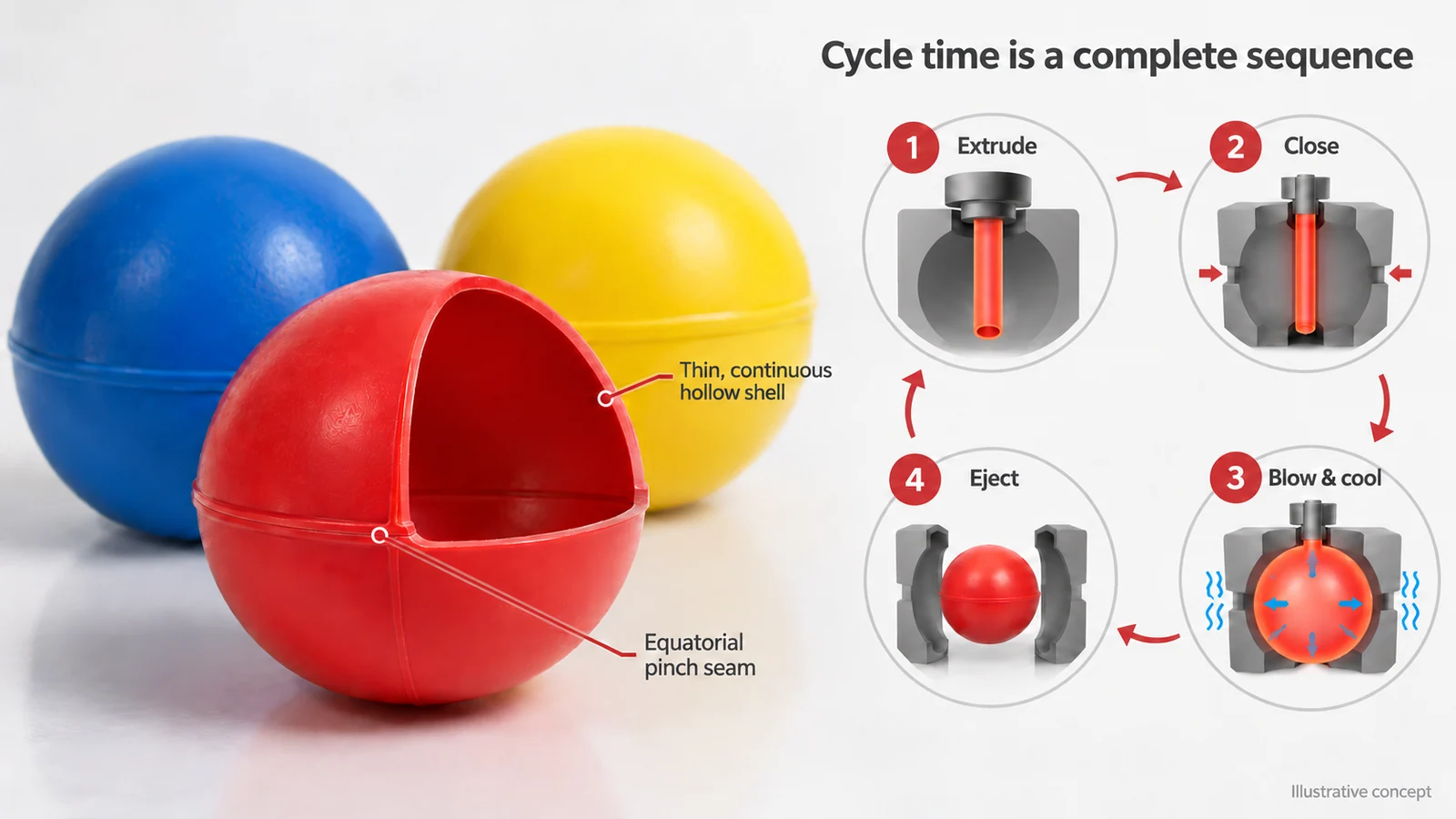
Ask which event starts and ends the timer. Confirm whether the count refers to one cavity group, one station, the full machine sequence or the interval between delivered products. Avoid multiplying by station count when that output is already included.
The source describes a bottom-blowing arrangement coordinated with continuous extrusion. Its practical value should be assessed through the complete forming, cooling, venting and ejection sequence. Process names or motion overlap alone do not prove that a finished ball will be acceptable at the quoted speed.
Inspect the parts that come out of the faster cycle
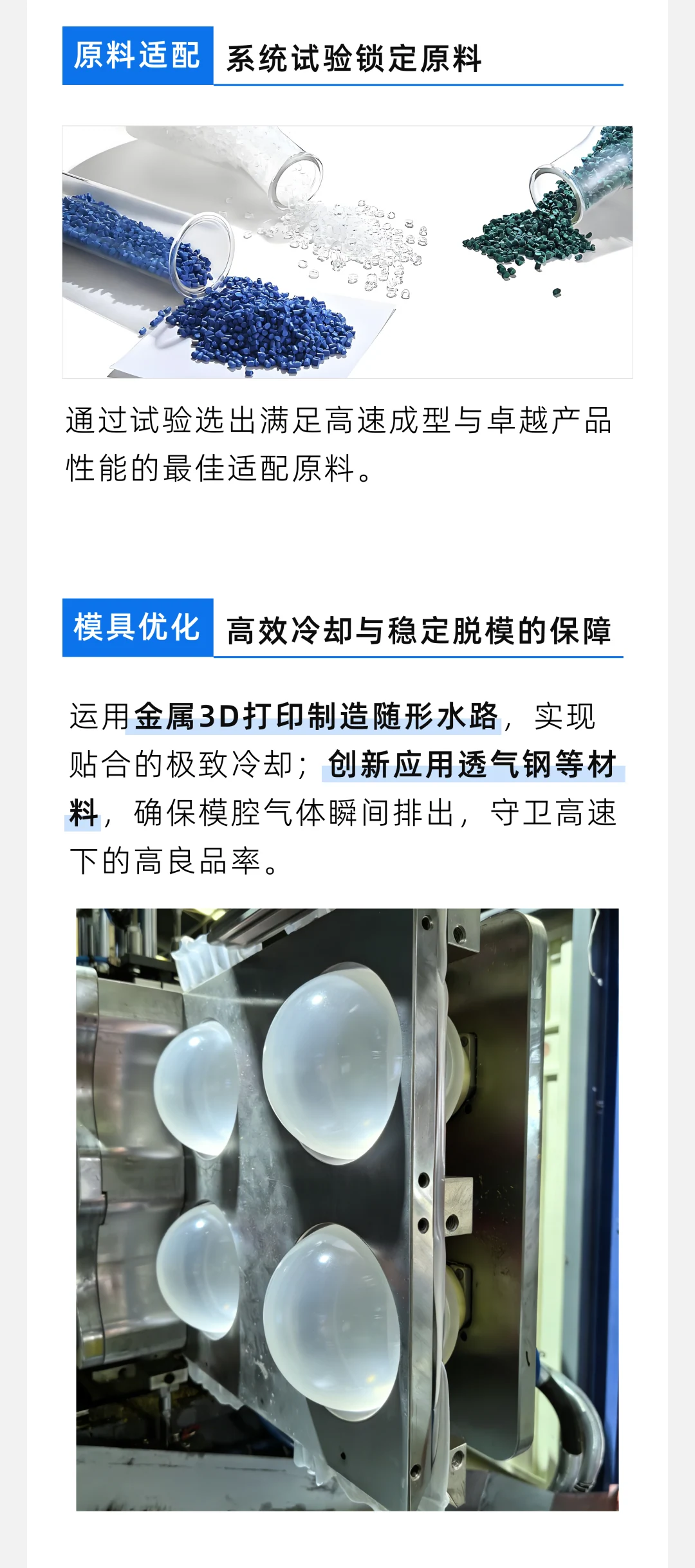
Define the ball dimensions, mass, wall distribution, seam condition and any relevant functional tests. A shorter cooling stage may change the condition in which a part is ejected. Inspect samples after the agreed conditioning period and classify rejects rather than counting every molded piece as saleable output.
Review mold cooling and venting with the intended resin. The source describes tooling and control changes as part of the project; verify the exact arrangement in a new quotation. No single cooling feature substitutes for a timed production trial.
Find the next production bottleneck
A faster molding machine can expose limitations elsewhere in the plant. Check material preparation and delivery, compressed air, cooling-water capacity, part take-out, trimming, inspection and packing. Identify any manual work that must keep pace with the delivered-part interval.
For example, a 1,440-part theoretical hourly rate multiplied by an illustrative 85% availability and 97% accepted yield gives about 1,187 accepted parts per scheduled hour. Those percentages are an example for planning, not measured results from Tongda’s case. Use the buyer’s actual records for an investment decision.
Keep the trial report useful after commissioning
Record the mold and resin identifiers, cavity count, cycle definition, trial duration, accepted count, rejects and utility conditions. Save the recipe and document changes to tooling or material. This creates a baseline for later shifts and helps distinguish machine issues from changes elsewhere in the line.
Questions buyers ask
Does a ten-second cycle guarantee 34,560 saleable balls per day?
No. That total assumes four parts every ten seconds for 24 hours without losses. Actual output must account for availability, quality and downstream constraints.
Which machine should I start evaluating?
Start with the ball drawing, resin, cavity plan and accepted-output target. Review hollow-ball applications and the HS 12 L platform, then request a production trial proposal.
Adapted from Tongda’s original WeChat article. Case figures are manufacturer-reported for the described application. Original photographs and English concept illustrations are identified in their captions.