Published 4 min readTechnology
Existing blow molds can sometimes be reused when upgrading to continuous extrusion, but compatibility must be engineered and demonstrated. Mold dimensions, mounting, neck orientation, machine motions, cooling and trimming all matter. Matching the nominal container volume is not enough to establish a direct fit.
Tongda’s CFV-50A project was developed around a customer’s existing bottom-blow tooling. The useful lesson is the approach: define tooling reuse as a requirement at the start, audit the interfaces, and prove the proposed combination in a trial before assigning a value to the retained molds.
Inventory the molds and the products they actually make
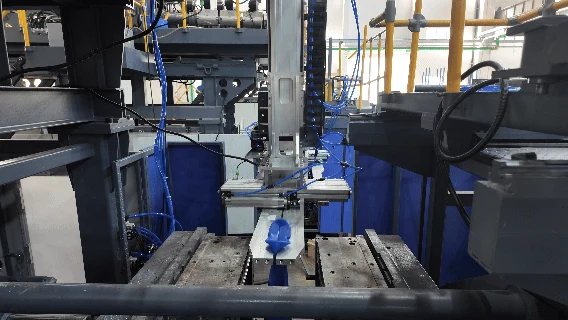
Create a record for each mold, including the drawing revision, condition, cavities, product drawing, material, weight and recent production history. Separate molds that remain commercially useful from tools that need refurbishment or no longer suit the product range.
Record the current machine and process as well. A mold that has run successfully on one installation carries useful evidence, but its previous performance does not establish compatibility with a different platform. Worn tooling can also make it difficult to separate an existing defect from a new process problem.
If several molds are involved, identify representative extremes: the largest envelope, heaviest tool, most demanding neck orientation and most difficult product geometry. Agree which tools must be demonstrated rather than assuming a single successful trial proves the entire inventory.
Audit the mechanical and process interfaces
| Interface | What to compare |
|---|---|
| Mold envelope | Platen area, opening, thickness and clearance through all motions |
| Mounting and support | Fixing pattern, locating features, support and tool mass |
| Neck and blowing | Blow-pin direction, neck tooling, access and sealing geometry |
| Services and handling | Cooling connections, take-out, trimming and inspection |
Check clearances with the complete tooling, connections and guarding arrangement. Evaluate the closing and transfer motions as a sequence, including access for maintenance and changeover. A drawing that shows the mold inside the platen area does not establish clearance through the full cycle.
For a bottom-blow design, examine the relationship between the existing neck tooling and the new blow-pin arrangement. Any adapter, new service connection or tooling modification belongs in the quotation and acceptance plan.

Distinguish the forming mold from extrusion die tooling
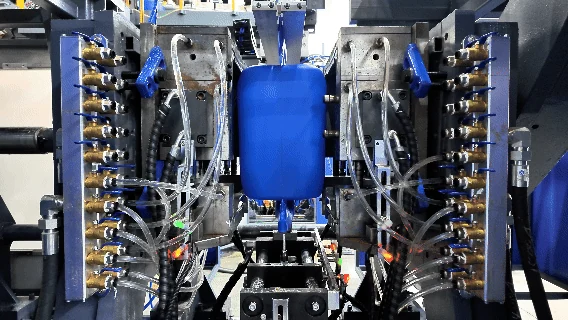
The forming mold shapes the outside of the container. The extrusion die and mandrel or bushing help form the parison before the mold captures it. Changing one does not mean changing the other.
The CFV-50A description refers both to retained customer molds and to extrusion die-tooling changes. For a new enquiry, ask exactly which components can be retained, which need modification and which will be supplied new. Include neck tooling, cutting and deflashing fixtures in that discussion.
This distinction is especially important when a supplier quotes a short tooling change. The quoted operation may concern an extrusion component rather than a complete product changeover with a forming mold, services and downstream settings.
Prove the new process with the retained tool
Continuous extrusion changes how the parison is presented and coordinated with machine motion. Validate the material, parison dimensions, profile, capture position and handling with the intended tool. Compare finished weight, wall distribution, neck dimensions, pinch-off and accepted output against agreed requirements.
Claims about faster color changes or fewer black specks need a controlled comparison. Specify the starting and ending colors, cleaning procedure, transition waste and acceptance rule. Flow-path design, residence time, maintenance and operating practice influence the result; the process name alone does not guarantee an improvement.
Keep the final recipe and trial records with the mold’s identifier. For multilayer operation, add the relevant layer and package checks rather than assuming that a mold qualified for a single-layer product proves a new barrier package.

Compare the full upgrade cost
Tooling reuse can reduce the need to purchase replacement molds. Its value must be assessed alongside inspection, refurbishment, adapters, new extrusion tooling, trials, training, installation and the planned production interruption.
Compare three practical options where relevant: retain and adapt the current tooling, selectively replace the most demanding molds, or buy new tooling designed for the new machine. Use expected accepted output and maintenance requirements, rather than assigning every stored mold its original purchase value.
For the wider platform specification, see the HTS configuration guide. For tooling design inputs, use the blow mold manufacturing guide. These are separate decisions from proving that one retained mold fits one new installation.
Questions buyers ask
Will my old molds fit without modification?
Only an interface review and trial can establish that. The CFV-50A project demonstrates a machine engineered around a particular customer’s bottom-blow tooling, not universal interchangeability.
Can automation simply be connected later?
Confirm space, product presentation, controls, guarding and the exact interfaces supplied. An available interface still requires an integration assessment for the chosen downstream equipment.
What should accompany a tooling-reuse enquiry?
Send mold drawings, photographs, product samples, service details and current production records. Review the jerry can and stackable container applications, then request a mold-compatibility review before choosing the upgrade scope.
Source material: Tongda WeChat article 20. Source photographs and video stills retain the original equipment details. English concept illustrations are identified in their captions.